
.jpg)
On the trip Celestron says these binoculars show fine detail in dim light like dawn, when the geese lift off the water.
Skip them if you already own binoculars. At about 25 ounces, they are not a pocket pair.
Middle Rio Grande
Bosque del Apache is a winter crane and goose destination built around a 12-mile Auto Tour Loop. Plan for dawn fly-out or evening fly-in from early November through late January, then verify current hours, fees, and refuge conditions.
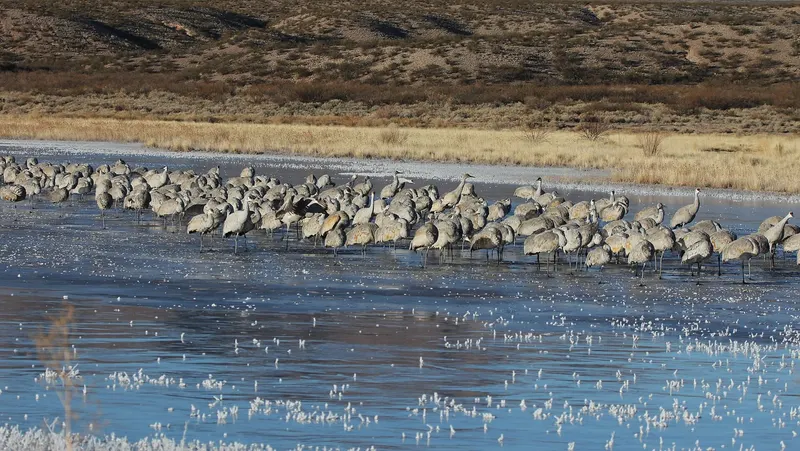
Jason Crotty · Wikimedia Commons · CC BY 2.0Bosque del Apache National Wildlife Refuge is best planned around movement, not a midday checklist. From early November through late January, cranes and geese leave their nighttime water at dawn and return at evening. The 12-mile Auto Tour Loop and named viewing decks let visitors choose a position before fly-out or fly-in, then move through managed wetlands, ponds, and fields after the main flight.
The refuge is open year-round. First crane arrivals begin in late October, with the peak from early November through late January. Spring brings wetland drawdowns for shorebirds, while summer is quieter and hot, with mornings and evenings the more practical times.
Bosque del Apache covers 57,331 acres in the Middle Rio Grande floodplain between the Chupadera Mountains to the west and San Pascual Mountains to the east. This is the northern Chihuahuan Desert, but water management creates the refuge’s central habitat pattern.
President Franklin D. Roosevelt established the refuge on November 22, 1939 through Executive Order 8289 to provide refuge and breeding grounds for migratory birds. In 1975, 30,427 acres were designated wilderness.
The U.S. Fish and Wildlife Service moves river water through fields, marshes, and ponds with gates and ditches, then returns it to the river to mimic natural flooding cycles. Managers rotate moist-soil units that grow native foods including smartweed, millets, chufa, bulrush, and sedges. Supplemental corn and triticale add forage.
Thousands of snow geese, Ross’s geese, and sandhill cranes spend winter nights in water. More than 20 duck and goose species winter at the refuge, along with hawks and eagles. Mule deer, coyotes, jackrabbits, and javelina are also part of the refuge wildlife list.
The refuge does not publish a current crane count for its own boundary. Friends of Bosque del Apache cites a U.S. Fish and Wildlife Service biologist who estimates 17,000–20,000 greater sandhill cranes across the Middle Rio Grande valley. That is a valley-wide figure, not a promise of how many birds will be visible from one refuge deck.
Dawn is the fly-out window. Geese can take off together in a large mass as birds leave the water. Evening reverses the movement as cranes and geese return for the night. Early November through late January is the peak seasonal window.
Before a dawn visit:
The fly-out starts at dawn, often below freezing. Bring what you own first.
As an Amazon Associate, we earn from qualifying purchases.
On the trip Celestron says these binoculars show fine detail in dim light like dawn, when the geese lift off the water.
Skip them if you already own binoculars. At about 25 ounces, they are not a pocket pair.
On the trip It covers 715 western bird species, including these cranes and geese, and needs no phone.
Skip it if you will use Cornell Lab’s free Merlin Bird ID app. It uses illustrations, not photos, and runs 504 pages.
On the trip For the still, cold wait before sunrise, HotHands says each warmer gives up to 10 hours of heat.
Each pair works only once, and the maker says not to apply them directly to skin. Skip them if your gloves already keep your hands warm on a freezing evening or dawn.
Bosque del Apache
Planning location: 33.869°, -106.843°. Confirm the entrance and current access before traveling.
Open the location map ↗Coordinate: Wikipedia: Bosque del Apache National Wildlife Refuge
Checked .
The Auto Tour Loop combines North and South loops for a 12-mile route with one-way segments. It is open daily from one hour before sunrise to one hour after sunset throughout the year. The speed limit is 25 mph. Begin with the visitor information page to confirm current access.
Construction notice, checked September 29, 2026: the refuge says work on water-control infrastructure around the Tour Loop begins around September 29, 2026 and may require intermittent road closures, with no precise schedule. For daily closures, it asks visitors to call the Visitor Center at 575-835-1828 the day before or the day of the visit.
Named observation points make it easier to choose a stop. The Flight Deck has vault toilets. Dabbler and Diver Deck, Willow Deck, and the Marsh Overlook add other wetland views. Marsh Overlook includes viewing windows and an observation blind. The refuge also identifies twelve nature trails.
Bicyclists can use about 11 miles of the low-traffic gravel Low Flow Conveyance Channel East Service Road. The refuge does not allow camping or overnight parking, so a dawn visit requires an off-refuge overnight plan.
The Visitor Center is at 1001 State Highway 1 in San Antonio. At our September 29 check, its posted schedule was Thursday through Tuesday from 9 a.m. to 4 p.m., closed Wednesdays. Hours can change and should be verified before using the building as part of the itinerary.
The posted day-use fee was $5 for a private vehicle. A refuge annual pass was $15, and a Duck Stamp admitted the holder. These amounts are volatile, so check current fees rather than treating them as permanent.
From the north, take I-25 exit 139 at San Antonio, go east for one-quarter mile on US-380 to the flashing signal, then turn south on Highway 1. From the south, use I-25 exit 115. The refuge does not publish a dependable mileage from Albuquerque or Socorro, so directions are more useful than an estimated drive time.
San Antonio provides a nearby food stop. New Mexico Tourism identifies two rival green-chile-cheeseburger institutions there, the Owl Bar & Café and the Buckhorn Tavern.
The 37th Festival of the Cranes is scheduled for December 2–5, 2026. Friends of Bosque del Apache links the 2026 agenda. Use its current festival page for the program, registration information and availability; the published agenda does not guarantee a place in a particular event.
The festival falls within the wider early-November-to-late-January peak. A non-festival visit can still use the same dawn fly-out and evening fly-in pattern without assuming a festival schedule or program.
Drones are prohibited. Dogs may be walked on leash. Stay on established roads because off-road driving is not allowed, and do not feed wildlife or build an open fire.
Hunting takes place in three designated hunt units under annual rules, but the Tour Loop area is closed to hunting. Season dates change by year, so the current refuge regulations control. Camping and overnight parking remain prohibited throughout the refuge.
The practical plan is compact: verify the loop and visitor-center status, choose dawn or evening, allow time for the 25 mph route, and leave the refuge before the nightly closing window. In winter, the birds supply the schedule.
Peak period per the refuge; festival dates per Friends of Bosque del Apache, as recorded in this guide
Checked .
The refuge identifies early November through late January as the peak period, with first arrivals in late October. Dawn fly-out and evening fly-in are the key daily viewing times.
The combined North and South loops cover 12 miles and include one-way segments. The speed limit is 25 mph.
No. Camping and overnight parking are not allowed on the refuge.
The refuge listed a $5 daily fee for a private vehicle and a $15 refuge annual pass at our September 29, 2026 check. A Duck Stamp also admits the holder. Check current fees before arrival.
The Tour Loop is open daily from one hour before sunrise to one hour after sunset. Starting around September 29, 2026, the refuge says construction on water-control infrastructure may close parts of the loop intermittently, without a precise schedule. Call the Visitor Center at 575-835-1828 the day before or the day of your visit.
The 37th Festival of the Cranes is scheduled for December 2–5, 2026. Friends of Bosque del Apache links the 2026 agenda; use its current festival page for the program, registration information and availability.
Official visitor information: Bosque del Apache refuge overview, Bosque del Apache conservation work, Bosque del Apache wildlife species, Bosque del Apache wildlife watching, Bosque del Apache visitor information, Bosque del Apache laws and regulations, Friends of Bosque del Apache Festival of the Cranes, New Mexico Tourism San Antonio guide, NOAA 1991-2020 climate normals, Bosque del Apache station.
Photography via Wikimedia Commons. Images resized and cropped for layout; individual credits and reuse licenses are listed below.
Guide details checked . Confirm current conditions before traveling.